

ContextOS

Project Type:
Master's Thesis Project
Role:
AR Product Designer
Prompt Engineer
Built with:
Spectacles
Lens Studio
Gemini Live
Notion API
Timeline:
Feb - May 2026
PawPath is a companion-based AR wayfinding concept for Snap Spectacles. By replacing abstract 2D maps with a virtual cat guide, it transforms navigation into an instinctive, "hands-free" following experience. The project focuses on reducing cognitive load through spatial UI and ground-anchored cues for seamless indoor navigation.
Project Type:
Independent UX/UI Design & Branding Project
Role:
UX/UI Designer, Branding, Prototyping
Platforms:
iOS & Android Mobile App
Timeline:
8 Weeks
The Problem:
Most navigation experiences are designed as static 2D map interfaces. Even when AR is introduced (e.g., "live view" on a mobile phone), users must constantly switch their attention between a handheld screen and the real environment. This creates high cognitive load, and introduces social discomfort from holding a phone up in front of others.
Challenge:
With smart glasses, there is an opportunity to rethink wayfinding as "instinctive following" instead of "map reading." How might we create a companion-based AR experience that helps users navigate by following movement without blocking their primary field of view or overwhelming the scene with visual clutter?
PawPath
Companion-Based AR Wayfinding
Project Type:
Self-Led Project
Role:
UX/UI Designer · Spatial Interaction Designer
Platforms:
Snap Spectacles · Lens Studio · Figma · Blender
Location:
NYIT Digital Art & Design Campus
Timeline:
Nov - Dec, 2025
Overview
ContextOS explores how AI-powered spatial computing can support human memory and professional workflows without requiring constant interaction with phones or screens.
The system uses contextual signals such as environment, calendar events, and voice input to proactively deliver relevant information through AR glasses.

The Problem
Today’s interfaces
compete with reality.
Four frictions our research surfaced again and again in observing knowledge workers across studios, labs and meetings.
01
Screen Dependency
Every answer requires a glance away from the world.

02
Temporal Mismatch
Every answer requires a glance away from the world.
_edited.jpg)
03
Modality Saturation
Every answer requires a glance away from the world.
_gif.jpg)
04
Fragmented Systems
Every answer requires a glance away from the world.
_edited.jpg)
The Solution
Productivity, made ambient.
ContextOS transforms productivity tools into an ambient spatial workflow — surfacing meetings, decisions, and people in the moment, then quietly filing everything away when you’re done.

.png)
.png)


Problem:
Idea:
Indoor navigation makes people stop, hesitate, and constantly “re-orient” using 2D maps.
Replace map reading with instinctive following through a calm companion and environment-anchored cues.
Solution:
Outcome:
A cat guide + ground-anchored Paw Trail + Target Point that reinforces spatial trust.
A coherent spatial UI concept + prototype direction for hands-free wayfinding on smart glasses.

Companion Guide (Cat)
A small cat companion walks slightly ahead, slows or pauses at decision points, and re-orients to guide the user without demanding attention.
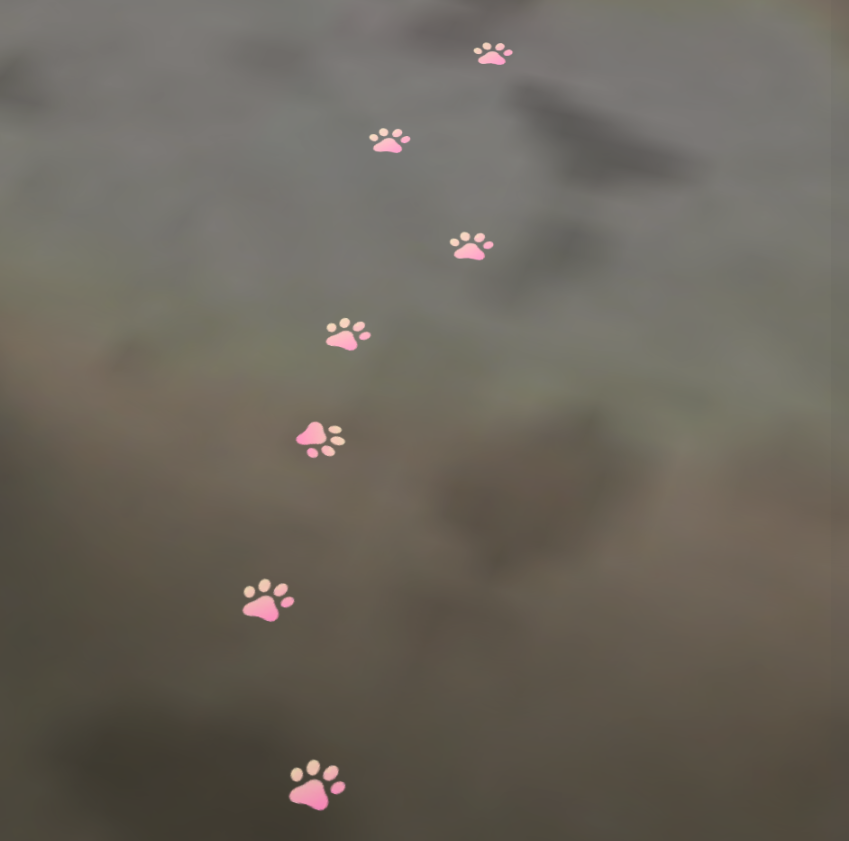
Paw Trail (Ground-anchored path)
A lightweight, low-opacity trail on the ground creates a “followable” route that feels connected to the space rather than floating UI.

Target Point (Destination confirmation)
A calm destination marker reassures users they’re going the right way and clearly communicates arrival.
The System
A scenario-based interaction framework used to validate
PawPath’s end-to-end flow across different spaces and destinations.


Competitive Landscape
